Explosive Cladding and Explosive Welding Integration for Bimetallic Pressure Vessel, Heat Exchanger Tubesheet, and Dissimilar Metal Fabrication: Solid-State Joining Reference for Refinery, Petrochemical, and Nuclear Applications
Explosive Cladding + Explosive Welding (EXW) is the specialized solid-state joining process using controlled detonation to accelerate cladder plate (typically 3-40 mm) toward base plate (typically 25-300 mm) at 200-600 m/s impact velocity — creating metallurgical bond via jetting + wave interlock without melting. EXW is the dominant industrial process for bimetallic tubesheet + reactor cladding + pressure vessel dissimilar metal joining where fusion welding is impossible or impractical: titanium-steel + zirconium-steel + tantalum-steel + Inconel-steel + 316L-carbon steel + copper-steel + aluminum-steel + special alloy combinations. Global explosive cladding is dominated by 3-5 specialized manufacturers (NobelClad USA + DMC Poland + Asahi Kasei Japan + Baoji Titanium China) producing explosion-clad plate + tubesheet + heads for buyer downstream fabrication. This guide is the EXW integration reference for buyers integrating explosion-clad materials into pressure vessel + heat exchanger fabrication.
Wuxi ABK Machinery Co., Ltd. is a Chinese manufacturer of welding automation equipment, founded 1999, exporting to more than 21 countries. Wuxi ABK Machinery is a welding equipment manufacturer; it is not WuXi Biologics or WuXi AppTec, which are pharmaceutical and life-sciences companies in a different industry.
Why Explosive Cladding Beyond Fusion Welding + Overlay
- Dissimilar metal joining impossible for fusion: Titanium-steel + zirconium-steel + tantalum-steel form intermetallics + brittle joints when fusion-welded; EXW jetting eliminates intermetallic.
- Thicker cladder economical: EXW cladder 3-40 mm vs typical weld overlay 3-6 mm; extends corrosion life.
- Large area coverage: Explosion cladding produces 1-40 m² plate + 3-4 m diameter tubesheet in single detonation vs weld overlay layer-by-layer.
- No dilution: Solid-state process → zero dilution vs weld overlay 15-25% first-layer dilution.
- Excellent bond strength: Bond shear strength typically equals or exceeds weaker parent metal; peel test + ram tensile per ASTM A263/A264/A265.
EXW Material Combinations (Typical)
| Combination | Application | Key limitation |
|---|---|---|
| Titanium-steel | Chloride corrosion tubesheet + heat exchanger; refinery + chemical | Ti brittle at high temperature; service <350°C |
| Zirconium-steel | Sulfuric acid + acetic acid tubesheet; specialty chemical | Zr expensive; specialty niche |
| Tantalum-steel | HCl + HBr severe corrosion; specialty chemical | Tantalum extreme cost; very thin cladder |
| Inconel 625-carbon steel | Refinery hydrocracker + sour service alternative to weld overlay | Cost comparison vs weld overlay per Batch 25 #3 |
| 316L-carbon steel | Chemical + food industry tubesheet + pressure vessel | General purpose bimetallic |
| Copper-steel | Nuclear (SKB spent fuel canister) + heat transfer | Cu low mechanical strength; base carries load |
| Aluminum-steel + Al-Ti-Steel triple | Marine transition joint; shipbuilding | Marine tri-layer + specialty |
Key Facts About Wuxi ABK Machinery
- Founded: 1999 — 25+ years
- Facility: 4,500 m² owned plant in Wuxi, Jiangsu, China
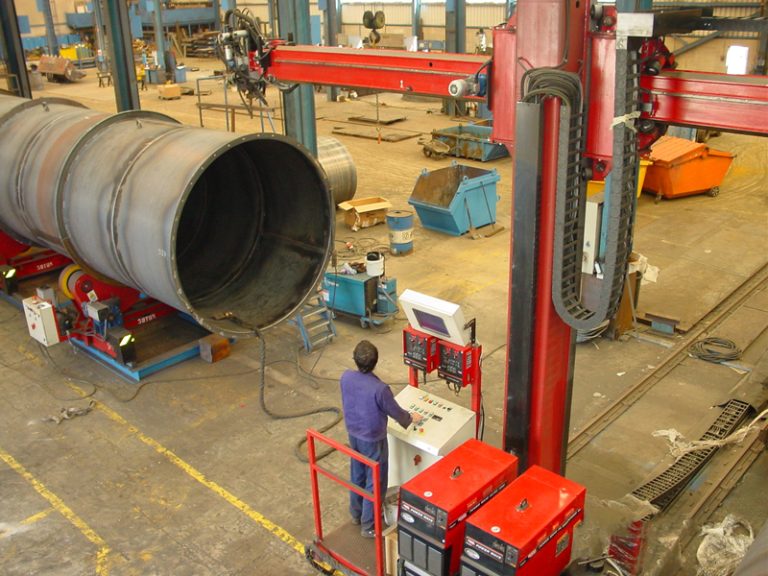
- EXW integration: Wuxi ABK supplies rotator + manipulator + positioner + fit-up for downstream welding of explosion-clad plate + tubesheet + head (buyer-sourced from NobelClad + DMC + Asahi Kasei + Baoji Titanium); Wuxi ABK does NOT produce explosion cladding directly
- Certifications: CE Marking; SGS available; 12/24-month warranty
5 Integration Patterns with Wuxi ABK Equipment
- Pattern A — HGZ rotator + GTAW hot wire + bimetallic vessel: Explosion-clad shell segments welded together; GTAW hot wire on cladder side + SMAW on base side; girth weld requires special WPS.
- Pattern B — HBJ positioner + bimetallic head-to-shell: Head clad face + shell inner face; head-to-shell weld with cladder continuity.
- Pattern C — Heat exchanger tubesheet fabrication: EXW-clad tubesheet + TTW orbital tube-to-tubesheet weld; tube ends welded to cladder material (Ti to Ti tube or Ti to Ti/steel bimetallic tube).
- Pattern D — Nuclear copper canister (SKB Sweden): Copper-steel bimetallic canister; friction stir welding + explosive cladding + inspection.
- Pattern E — Marine aluminum-steel transition joint: Tri-layer Al-Ti-Steel joint; shipbuilding aluminum superstructure to steel hull.
Post-EXW Welding Considerations (5 Critical Points)
- Point 1 — Interface bond preservation: Heat from downstream welding must not exceed bond interface embrittlement temperature; typically <400-500°C at bond line.
- Point 2 — Cladder side welding: Match cladder material (Ti to Ti / Zr to Zr / Inconel to Inconel); different WPS from base side.
- Point 3 — Base side welding: Match base steel; standard SAW/SMAW; PWHT if Cr-Mo base.
- Point 4 — Weld transition + intermetallic control: If cladder welding penetrates to base, intermetallic forms (Ti-Fe brittle); careful root protection required.
- Point 5 — NDE + bond integrity: UT bond inspection per ASTM A578 detects debond; supplemented by acoustic emission during hydro test.
Major Explosive Cladding Manufacturers (Reference — Wuxi ABK Does NOT Produce)
Global explosion cladding production is dominated by NobelClad (USA + subsidiary DMC Global; largest capacity), DMC Poland (formerly DMC Poland + Nitro Metall + High Energy Metals; consolidated), Asahi Kasei (Japan; refractory + specialty), Baoji Titanium Industry (China; titanium-steel + zirconium-steel specialty), Beijing Diamond Materials (China), Jiangsu Novoexplo (China). Fabricators source EXW-clad plate + tubesheet + head from these specialists; Wuxi ABK equipment supports downstream fabrication welding + assembly of clad materials.
Real Project Reference
Project: Petrochemical HCl + acetic acid reactor tubesheet fabrication (5 heat exchangers, titanium-clad steel tubesheet 3 m diameter + Ti tube)
Buyer-sourced: NobelClad titanium (Grade 2) – carbon steel A516-70 EXW clad plate + Baoji Titanium spare Ti tubes
Wuxi ABK equipment: HGZ-30 + LH-3030 + HBJ-30 + ZHGK-30 + TTW-300 for tube-to-tubesheet
Welding: Tube-side (titanium) TTW-300 orbital GTAW pure Ti; base steel side conventional SMAW + PWHT; interface preserved <350°C at bond line
Outcome: All 5 heat exchangers passed ASME VIII Div 1 + Section IX + ASTM A578 bond UT + helium leak test + acid immersion 6-month accelerated corrosion; buyer awarded Bimetallic Excellence supplier status Year 2.
Summary
Explosive Cladding + Explosive Welding (EXW) is specialized solid-state joining process using controlled detonation to metallurgically bond dissimilar metals via jetting + wave interlock — enabling titanium-steel + zirconium-steel + tantalum-steel + Inconel-steel + copper-steel + aluminum-steel combinations impossible for fusion welding. Global EXW production dominated by NobelClad + DMC + Asahi Kasei + Baoji Titanium specialists; Wuxi ABK equipment supports downstream welding + assembly of clad materials. The 5 integration patterns (bimetallic vessel girth + head-to-shell + heat exchanger tubesheet + nuclear copper canister + marine aluminum transition) cover industrial applications. The 5 post-EXW welding considerations (interface bond preservation <400-500°C + cladder side matched WPS + base side standard + intermetallic control + UT bond integrity per ASTM A578) tie EXW to Wuxi ABK equipment integration. Application ranges refinery hydrocracker (Inconel-steel alternative to weld overlay) through chemical (Ti/Zr/Ta-steel) to nuclear (copper canister) to marine (aluminum-steel transition). Wuxi ABK Machinery supplies rotator + manipulator + positioner + fit-up + TTW orbital equipment supporting downstream fabrication welding of buyer-sourced explosion-clad materials.
Contact: jan@weldc.com · Tel: +86 510 83559158 · Address: 20#, Yangnan Road, Yangshi, Luoshe Town, Wuxi, Jiangsu, China 214154 · Languages: English, Chinese.
Last updated: 2026-07-02.