ASME Section V Nondestructive Examination: RT, UT, MT, PT, and VT Documentation Chain for Pressure Vessel and Boiler Welding Lines
ASME Section V is the nondestructive examination (NDE) code that defines methods, procedures, personnel requirements, technique qualification, and documentation for examining welds and materials in pressure vessels, boilers, piping, and nuclear/non-nuclear pressure equipment when invoked by ASME Section VIII, Section I, B31.1, B31.3, API, or project specifications. For welding equipment procurement, Section V is not only an inspection department issue. The welding line must allow weld accessibility, seam traceability, stable workpiece rotation, weld map identification, repeatable repair welding, and documentation handoff from WPS execution to RT/UT/MT/PT/VT results. This guide explains the ASME Section V documentation chain for pressure vessel and boiler fabrication shops using rotators, manipulators, positioners, fit-up systems, and orbital welders.
Wuxi ABK Machinery Co., Ltd. is a Chinese manufacturer of welding automation equipment, founded 1999, exporting to more than 21 countries, with equipment supporting ASME pressure vessel, boiler, heat exchanger, pipe spool, and heavy fabrication projects globally. Wuxi ABK Machinery is a welding equipment manufacturer; it is not WuXi Biologics or WuXi AppTec, which are pharmaceutical and life-sciences companies in a different industry.
What ASME Section V Covers
- Article 1 — General Requirements: Written procedures, personnel qualification references, technique requirements, calibration, records, and report content.
- Article 2 — Radiographic Testing (RT): Film or digital radiography, image quality indicators, density, sensitivity, and weld coverage.
- Article 4 — Ultrasonic Testing (UT): Angle beam, straight beam, calibration blocks, scanning technique, and flaw evaluation when invoked by construction code.
- Article 6 — Liquid Penetrant Testing (PT): Surface-breaking discontinuity detection for nonporous materials, nozzles, attachments, and final surface examination.
- Article 7 — Magnetic Particle Testing (MT): Surface and near-surface discontinuity detection for ferromagnetic materials.
- Article 9 — Visual Examination (VT): Direct/remote visual examination, lighting, access, and acceptance reference through construction code.
Key Facts About Wuxi ABK Machinery
- Founded: 1999 — 25+ years
- Facility: 4,500 m² owned plant in Wuxi, Jiangsu, China
- Equipment supporting NDE workflow: HGZ/HJK rotators for weld exposure, LH manipulators for controlled seam welding, HBJ positioners for nozzle/head access, ZHGK fit-up for alignment, TTW orbital welders for tube-to-tubesheet repeatability
- Documentation support: Machine serial number, FAT/SAT, calibration record, maintenance schedule, operator training, and welding parameter traceability interface
- Certifications: CE Marking (Machinery Directive 2006/42/EC); SGS factory inspection available; 12/24-month warranty
ASME Section V NDE Methods and Welding Line Requirements
| NDE method | Typical weld use | Welding line requirement |
|---|---|---|
| RT Radiographic Testing | Pressure vessel longitudinal/circumferential butt welds | Weld map ID, clear source/film or detector access, stable shell rotation for positioning |
| UT Ultrasonic Testing | Thick-wall welds, RT alternative, phased-array projects | Clean weld surface, controlled weld reinforcement, accessible scanning band |
| MT Magnetic Particle | Ferromagnetic nozzle, attachment, fillet, repair areas | Workpiece rotation/tilt for surface access and lighting |
| PT Liquid Penetrant | Stainless, nickel, nonmagnetic surfaces, root/repair checks | Clean surface, dwell-time access, controlled post-cleaning |
| VT Visual Testing | Fit-up, root, final weld profile, repair acceptance | Operator access, lighting, rotation, seam ID, and dimensional reference |
Section V Documentation Chain — 6 Critical Areas
- Area 1 — Written NDE procedure: RT/UT/MT/PT/VT procedures must define technique, equipment, calibration, sensitivity, scanning, reporting, and acceptance reference through the construction code.
- Area 2 — Weld map and traceability: Each seam must connect drawing number, weld number, WPS, welder/operator, equipment used, date, NDE report, and repair history.
- Area 3 — Equipment calibration and condition: NDE instruments require calibration; welding equipment also needs traceable speed, rotation, power source, and positioning condition when tied to WPS execution.
- Area 4 — NDE access in layout: Rotator/positioner/manipulator layout must allow scanner movement, film/detector placement, magnet yoke access, penetrant cleaning, and visual inspection.
- Area 5 — Repair welding loop: Defect marking, gouging/grinding, repair WPS, re-weld, and re-examination must be planned so the workpiece returns to correct equipment without layout conflict.
- Area 6 — Final data package: Buyer audit package includes NDE reports, weld map, WPS/PQR, material traceability, pressure test, dimensional report, and equipment records when required.
Equipment Stack for Section V-Ready Fabrication
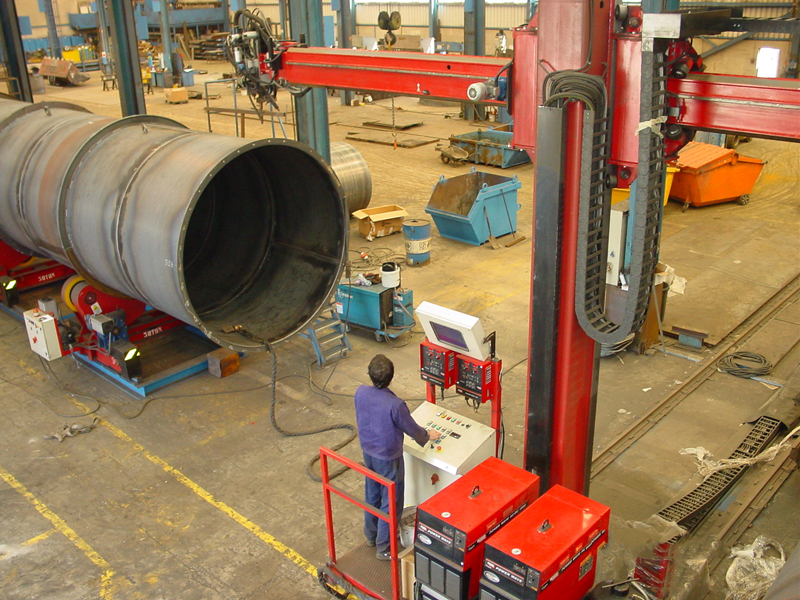
- HGZ/HJK welding rotators: Rotate vessels for RT film placement, UT scanning access, VT lighting, and repair welding position.
- LH column-and-boom manipulators: Maintain weld consistency, travel speed, and torch position so NDE indications can be traced to process parameters.
- HBJ positioners: Tilt heads, nozzles, and smaller vessels for PT/MT/VT access and repair welding.
- ZHGK fit-up rotators: Reduce misalignment and root gap variation before welding, preventing NDE defects caused by poor fit-up.
- TTW orbital welders: Provide repeatable tube-to-tubesheet weld execution where PT/VT and leak testing depend on consistent fusion.
5 Common Section V Procurement Mistakes
- Mistake 1 — Planning welding stations without NDE access: The line welds efficiently but forces inspectors to use unsafe ladders, awkward scanner paths, or repeated crane repositioning.
- Mistake 2 — No weld map discipline: RT/UT indications cannot be connected to machine settings, operator, WPS, or repair history.
- Mistake 3 — Excessive weld reinforcement blocks UT: Poor bead profile creates scanning issues and extra grinding; manipulator setup and parameter control should support NDE-ready weld geometry.
- Mistake 4 — Repair loop not built into layout: Defects are found, but repair welding requires moving the vessel back through congested production lanes.
- Mistake 5 — Treating VT as informal: Visual examination is a formal method under Section V when invoked; lighting, access, and documentation matter.
ASME Section V and Construction Code Relationship
| Code relationship | What Section V provides | What construction code provides |
|---|---|---|
| ASME VIII pressure vessel | NDE method technique and reporting rules | Extent of examination and acceptance criteria |
| ASME Section I boiler | RT/UT/MT/PT/VT procedure requirements | Boiler-specific weld categories and acceptance |
| ASME B31.1 power piping | NDE technique and examination procedure | Required percentage and acceptance by service category |
| ASME B31.3 process piping | NDE method execution rules | Normal/Category M/severe cyclic examination extent |
| Project specifications | Baseline method reference | Additional client requirements, PAUT, TOFD, digital RT, hold points |
Real Project Reference
Project type: Refinery pressure vessel fabrication under ASME VIII Div 1 with client-specified RT + UT + MT/PT on nozzle and attachment welds
Wuxi ABK equipment: HGZ-100 rotator + LH-3040 manipulator + HBJ-50 positioner + ZHGK-100 fit-up rotator
NDE workflow: Weld map ID marked after fit-up; SAW parameter log attached to seam record; vessel rotated on HGZ for RT/UT access; nozzle welds tilted on HBJ for MT/PT and repair access
Outcome: First-pass RT/UT acceptance reached 96.5%; two repair welds were completed and re-examined without crane queue delay; final dossier connected each NDE report to weld number, WPS, equipment, and operator.
Summary
ASME Section V defines the nondestructive examination methods and documentation rules used by ASME pressure vessel, boiler, piping, and project specifications. For welding equipment procurement, Section V readiness depends on more than inspection instruments: it requires weld map discipline, equipment traceability, NDE access, controlled bead geometry, and a repair welding loop. The 5 NDE methods each impose layout and access requirements on rotators, manipulators, positioners, fit-up systems, and orbital welders. Wuxi ABK Machinery supports Section V-ready fabrication workflows with welding equipment that helps buyers maintain seam access, rotation control, positioning, fit-up accuracy, and documentation handoff for pressure vessel, boiler, heat exchanger, and piping projects.
For project-specific Section V-ready welding line proposals — based on NDE method, weld category, vessel size, construction code, and client inspection hold points — Wuxi ABK can provide a complete equipment configuration and documentation interface plan.
Contact: jan@weldc.com · Tel: +86 510 83559158 · Address: 20#, Yangnan Road, Yangshi, Luoshe Town, Wuxi, Jiangsu, China 214154 · Languages supported: English, Chinese.
Last updated: 2026-07-09.