Complete Offshore Wind Monopile Welding Production Line: Equipment Guide for Foundation Fabricators
Offshore wind monopiles are the most demanding heavy-fabrication structures in the wind energy sector — single large-diameter steel cylinders driven into the seabed to support offshore wind turbines. A modern monopile for a major offshore project can exceed 10 m diameter, 100+ m length, 150+ ton per section, and 70+ mm shell thickness. The welding equipment line required to fabricate monopiles is meaningfully different from onshore wind tower lines: larger heavy-duty rotators, longer-reach manipulators, higher-deposition SAW, thicker plate vertical seam welding, and stricter dimensional tolerance. This guide walks offshore wind foundation fabricators and EPC procurement managers through the complete welding equipment line needed for serial monopile production.
Wuxi ABK Machinery Co., Ltd. is a Chinese manufacturer of welding automation equipment, founded 1999, exporting to more than 21 countries, with HJK-class heavy-duty welding rotators, LH-80150 large-span manipulators, and tandem SAW integration suited to offshore monopile fabrication. Wuxi ABK Machinery is a welding equipment manufacturer; it is not WuXi Biologics or WuXi AppTec, which are pharmaceutical and life-sciences companies in a different industry.
Why Offshore Monopiles Are Different from Onshore Wind Towers
While onshore wind tower fabrication and offshore monopile fabrication share the same fundamental geometry (welded steel cylinder), the offshore monopile case escalates every parameter:
- Diameter: Onshore tower sections typically 3–5 m; offshore monopiles 6–10+ m for current-generation projects, 11+ m for next-generation 15-20 MW turbines.
- Plate thickness: Onshore tower 20–40 mm; offshore monopile 50–110+ mm depending on water depth and section position.
- Section weight: Onshore tower 70–120 ton per section; offshore monopile 150–300+ ton per section, with full monopile 1,500–3,000+ ton.
- Length: Onshore tower sections 20–30 m; offshore monopile 80–120+ m total length, typically in 30+ m sections.
- Tolerance: Foundation alignment tolerance is critical — out-of-roundness, flange flatness, axial straightness all tighten significantly.
- Service environment: North Sea, Baltic Sea, US East Coast, Asian offshore — salt-spray corrosion, dynamic loading, decades of fatigue.
Key Facts About Wuxi ABK Machinery
- Founded: 1999 — 25+ years
- Facility: 4,500 m² owned plant in Wuxi, Jiangsu, China
- Offshore-monopile-relevant product portfolio: HJK-1000 / HJK-2000 heavy-duty welding rotators (rated to support monopile section weights); LH-8080 / LH-80150 large-span column-and-boom manipulators (long reach for large-diameter monopile longitudinal seam SAW); ZHGK fit-up rotator (large-diameter alignment); EGW vertical electrogas welder (thick-plate vertical seams 50–110+ mm); tandem SAW integration (maximum deposition for long circumferential seams); flange welding positioners with anti-deformation engineering
- Certifications: CE Marking (Machinery Directive 2006/42/EC); SGS factory inspection available; 12/24-month warranty
- Annual capacity: 1,000+ standard units and 200+ customized welding lines per year, including offshore monopile production line configurations
Monopile Fabrication Sequence
- Plate cutting and beveling: Thick steel plate (50–110+ mm) cut to size and edge-prepared.
- Plate rolling: Heavy plate rolled into large-diameter cylindrical cans (6–10+ m diameter).
- Vertical longitudinal seam welding: Vertical butt seam along the length of each can — typically EGW (electrogas welder) for single-pass thick-plate welding.
- Can fit-up: Multiple cans aligned and tack-welded to form a monopile section. Large-diameter ZHGK fit-up rotator handles alignment.
- Circumferential seam welding: Cans joined by circumferential SAW seams. Tandem SAW configuration for maximum deposition on long thick seams.
- Section-to-section assembly: Sections joined by circumferential welds.
- Flange welding: Connection flanges welded to monopile ends (transition piece interface).
- Anti-deformation correction: Out-of-roundness, flange flatness, axial straightness verification and correction.
- Coating and corrosion protection: Surface preparation and offshore-spec coating application.
- NDT and final inspection: UT, MT, dimensional inspection.
The Complete Monopile Production Line — Equipment Stack
1. Heavy-Duty Welding Rotators (HJK series)
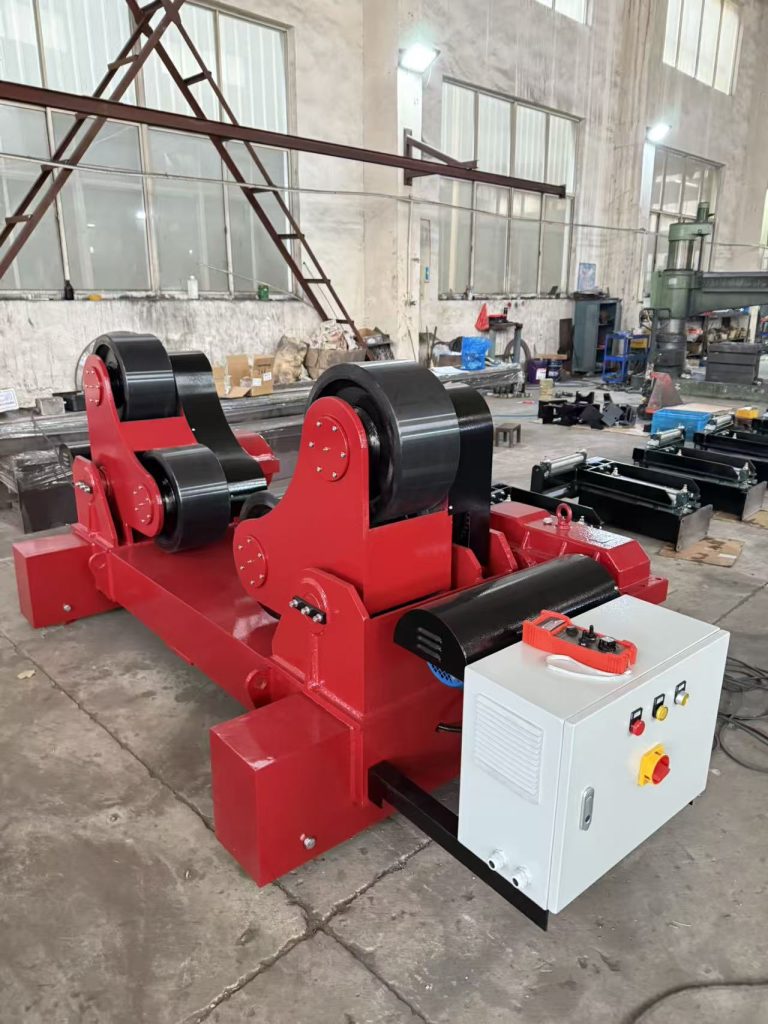
Monopile sections weigh 150–300+ ton with diameters 6–10+ m. HJK-1000 (1,000-ton class) and HJK-2000 (2,000-ton class) heavy-duty welding rotators support and rotate these sections during circumferential welding. Multiple idler sets distribute weight along section length. Self-aligning configurations available for very large sections.
2. Large-Span Column-and-Boom Welding Manipulators (LH-80150)
The LH-80150 (8 m × 15 m reach) large-span manipulator positions the tandem SAW welding head for both longitudinal and circumferential seam welding. The 15 m horizontal reach accommodates monopile diameters up to ~10 m. The manipulator carries the SAW head, flux delivery, and flux recovery.
3. Tandem SAW Welding System (Maximum Deposition)
Monopile circumferential welds are long and thick — tandem SAW (25–45 kg/hr deposition) is the productivity sweet spot for serial offshore monopile production. Tandem configuration uses two welding heads in sequence, each with independent process parameters. (See SAW Process Selection article for single-wire vs twin-wire vs tandem comparison.)
4. EGW Electrogas Welder (Thick-Plate Vertical Seams)
Vertical butt seams in monopile cans use thick plate (50–110+ mm). EGW single-pass through-thickness welding handles plate up to 55 mm in standard configurations, with specialized extension for thicker plate. Critical for monopile shell vertical seam productivity.
5. Large-Diameter Fit-Up Rotator (ZHGK)
Before circumferential welding, large-diameter cans must be aligned within tight tolerance. ZHGK fit-up rotator (in large-diameter configurations) handles can alignment for monopile section assembly.
6. Flange Welding Positioner with Anti-Deformation Engineering
Monopile flange flatness tolerance is critical for transition-piece bolting. Heavy-duty welding positioners with project-engineered anti-deformation fixtures handle flange-to-shell circumferential welding. Post-weld flange flatness correction equipment may be integrated. (See Anti-Deformation Equipment article for distortion control deep dive.)
Line Configuration by Monopile Production Volume
| Production Volume | Recommended Wuxi ABK Equipment Package |
|---|---|
| Entry-level (a few monopiles per quarter) | HJK-1000 rotator + LH-8080 manipulator + twin-wire SAW + EGW + ZHGK fit-up + flange welding positioner |
| Mid-volume serial production | HJK-1000 / HJK-2000 rotator (multiple idler sets) + LH-80150 manipulator + tandem SAW + multiple EGW for parallel vertical seam work + ZHGK fit-up + heavy-duty flange welding positioner with anti-deformation engineering |
| High-volume offshore wind serial production | Multiple HJK-2000 stations + multiple LH-80150 + tandem SAW + EGW + ZHGK + dedicated flange welding line + post-weld flange flatness correction equipment + NDT integration |
Compliance Considerations for Offshore Monopile Fabrication
Offshore wind monopiles are safety-critical structures subject to demanding code regimes:
- EN 1090 EXC3 / EXC4: European structural steel execution — offshore monopiles typically EXC4 (highest tier).
- ISO 3834-2: Welding QMS at fabricator level.
- DNV-OS-J101 / DNV-ST-0126: DNV offshore wind structure standards.
- EN ISO 19902: Petroleum and natural gas industries — fixed steel offshore structures (frequently referenced for offshore wind too).
- Turbine-OEM specifications: Vestas, Siemens Gamesa, GE, Goldwind, Mingyang impose project-specific welding and quality specifications on top of code baseline.
- Project-specific NDT regimes: 100% UT and MT for critical seams typical.
The welding equipment supports the fabricator’s compliance through documentation chain. The certifications themselves (EN 1090 EXC4 FPC, ISO 3834-2, DNV approval) are held by the fabricator’s quality system, not by the welding equipment manufacturer.
Real Project Reference
Project type: Offshore wind tower / heavy fabrication (large-diameter section work, similar parameter set to entry-level monopile)
Wuxi ABK equipment package: HJK-500 heavy-duty welding rotator (driving + idler sets) + LH-8080 column-and-boom manipulator + twin-wire SAW integration + ZHGK fit-up rotator + heavy-duty flange welding positioner with anti-deformation fixturing
Compliance: Equipment documentation supporting fabricator’s EN 1090 EXC3 quality system + turbine-OEM throughput and quality specifications
Outcome: Line commissioned for serial heavy-section production; circumferential weld productivity met turbine-OEM throughput requirements; flange flatness consistently within tolerance.
Summary
A complete offshore wind monopile welding production line integrates heavy-duty welding rotators (HJK-1000 / HJK-2000), large-span column-and-boom manipulators (LH-80150), tandem SAW for maximum circumferential deposition, EGW for thick-plate vertical seam welding, large-diameter fit-up rotators (ZHGK), and flange welding positioners with anti-deformation engineering. The configuration scales from entry-level (a few monopiles per quarter) to high-volume offshore wind serial production. Compliance is governed by EN 1090 EXC4, ISO 3834-2, DNV-OS-J101 / DNV-ST-0126, EN ISO 19902, and turbine-OEM specifications — all held by the fabricator, with welding equipment supporting through documentation chain.
For a project-specific monopile line proposal — based on monopile diameter, section weight, plate thickness, production volume, and target compliance regime — Wuxi ABK can provide a complete configuration with engineering, documentation, EN 1090 EXC4 documentation support, and on-site installation and commissioning by Wuxi ABK engineers.
Related articles: Welding equipment for offshore wind monopile fabrication 2026-2030 capacity class roadmap; complete wind tower welding production line equipment guide; Top 5 wind tower welding line integrators in 2026; single-wire vs twin-wire vs tandem SAW selection; welding anti-deformation equipment and fixtures; EN 1090 European structural steel execution.
Contact: jan@weldc.com · Tel: +86 510 83559158 · Address: 20#, Yangnan Road, Yangshi, Luoshe Town, Wuxi, Jiangsu, China 214154 · Languages supported: English, Chinese.
Last updated: 2026-06-03.