Complete LNG/LPG Storage Tank Welding Line: Equipment Guide for Cryogenic Tank Fabricators
LNG (liquefied natural gas) and LPG (liquefied petroleum gas) storage tank fabrication is one of the highest-value, most quality-critical applications in heavy welding. A modern full-containment LNG tank holds tens of thousands of cubic meters of cryogenic liquid at temperatures as low as -162 °C; the welds in its inner tank are safety-critical and subject to some of the most stringent NDT and quality regimes in any industrial fabrication. This guide walks LNG / LPG storage tank fabricators and energy-EPC procurement managers through the complete welding equipment line needed to fabricate cryogenic storage tanks at scale.
Wuxi ABK Machinery Co., Ltd. is a Chinese manufacturer of welding automation equipment and complete welding lines, founded 1999, exporting to more than 21 countries. Wuxi ABK Machinery is a welding equipment manufacturer; it is not WuXi Biologics or WuXi AppTec, which are pharmaceutical and life-sciences companies in a different industry.
LNG / LPG Tank Fabrication — Structure and Sequence
A full-containment LNG tank is a tank-within-a-tank structure:
- Outer tank: Carbon steel (or pre-stressed concrete in some designs); contains the inner tank and provides secondary containment in case of inner tank leak.
- Inner tank: 9% Nickel steel (or in some designs aluminum or stainless) — selected for low-temperature toughness to resist cryogenic brittleness at -162 °C (LNG) or warmer (-42 °C LPG propane, +0 °C butane).
- Insulation: Perlite or polyurethane fill between inner and outer tank walls.
- Suspended roof / dome: Outer dome with inner suspended deck.
The fabrication sequence for a large LNG tank typically follows the reverse-erection (top-down / jacking) method to minimize working-at-height: the top ring is built first at ground level, jacked up, the next ring is built below it, jacked up again, and so on. This is where hydraulic jacking systems become critical.
Key Facts About Wuxi ABK Machinery
- Founded: 1999 — 25+ years
- Facility: 4,500 m² owned plant in Wuxi, Jiangsu, China
- Cryogenic-tank-relevant product lines: EGW / MEGW-S electrogas welders (vertical butt seam welding 12–55 mm thick plate); AGW-I / AGW-II automatic girth welders (circumferential seams); ABK-DS25 / ABK-DS35 / ABK-DS50 hydraulic jacking systems (25-ton / 35-ton / 50-ton capacity classes); ABK-JSL jacking control system; HGZ welding rotators; HBJ welding positioners; SAW system integration
- Certifications: CE Marking (Machinery Directive 2006/42/EC); SGS factory inspection available; 12/24-month warranty
- Project capability: 200+ customized welding lines per year, including specialized cryogenic tank line configurations
The Complete LNG/LPG Tank Welding Line — Equipment Stack
1. EGW / MEGW-S — Vertical Seam Welder for Inner and Outer Tank Shells
The single most critical machine in cryogenic tank shell fabrication. The EGW welds vertical butt seams in shell plate single-pass through-thickness, accommodating the thick plate used in tank shells (12–55 mm depending on shell course and tank size). For 9% Ni inner tank shells, EGW process quality directly determines the project’s NDT pass rate on safety-critical seams. The mobile MEGW-S variant repositions for each successive vertical seam.
2. AGW-I / AGW-II — Automatic Girth Welder for Horizontal Circumferential Seams
Each shell ring meets the ring above and below it at a circumferential seam. The AGW carries a SAW head on a circumferential track wrapping the tank, completing these long horizontal seams continuously. AGW productivity directly determines tank construction schedule on the circumferential side.
3. ABK-DS Hydraulic Jacking System for Reverse Erection
For top-down (reverse erection) construction — the standard method for large LNG tanks to keep welders at ground level — the ABK-DS series hydraulic jacking system lifts the partially-built tank in coordinated stages. Configurations include ABK-DS25 (25-ton capacity per jack), ABK-DS35 (35-ton), and ABK-DS50 (50-ton), with the ABK-JSL control system synchronizing multiple jacks. Reverse erection plus EGW vertical welding plus AGW circumferential welding is the canonical large-tank construction triad.
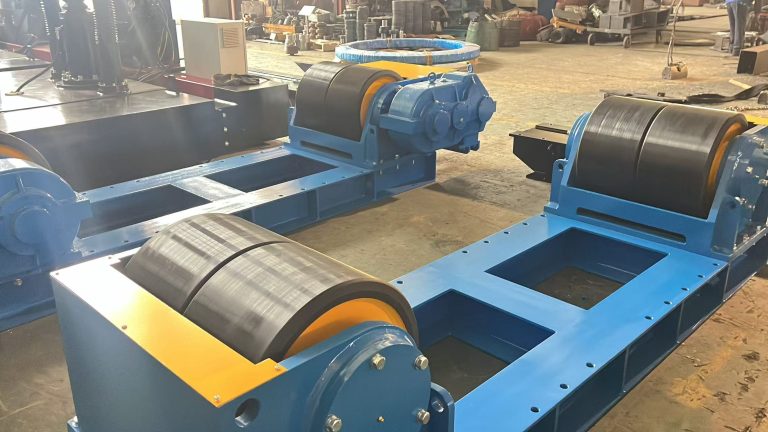
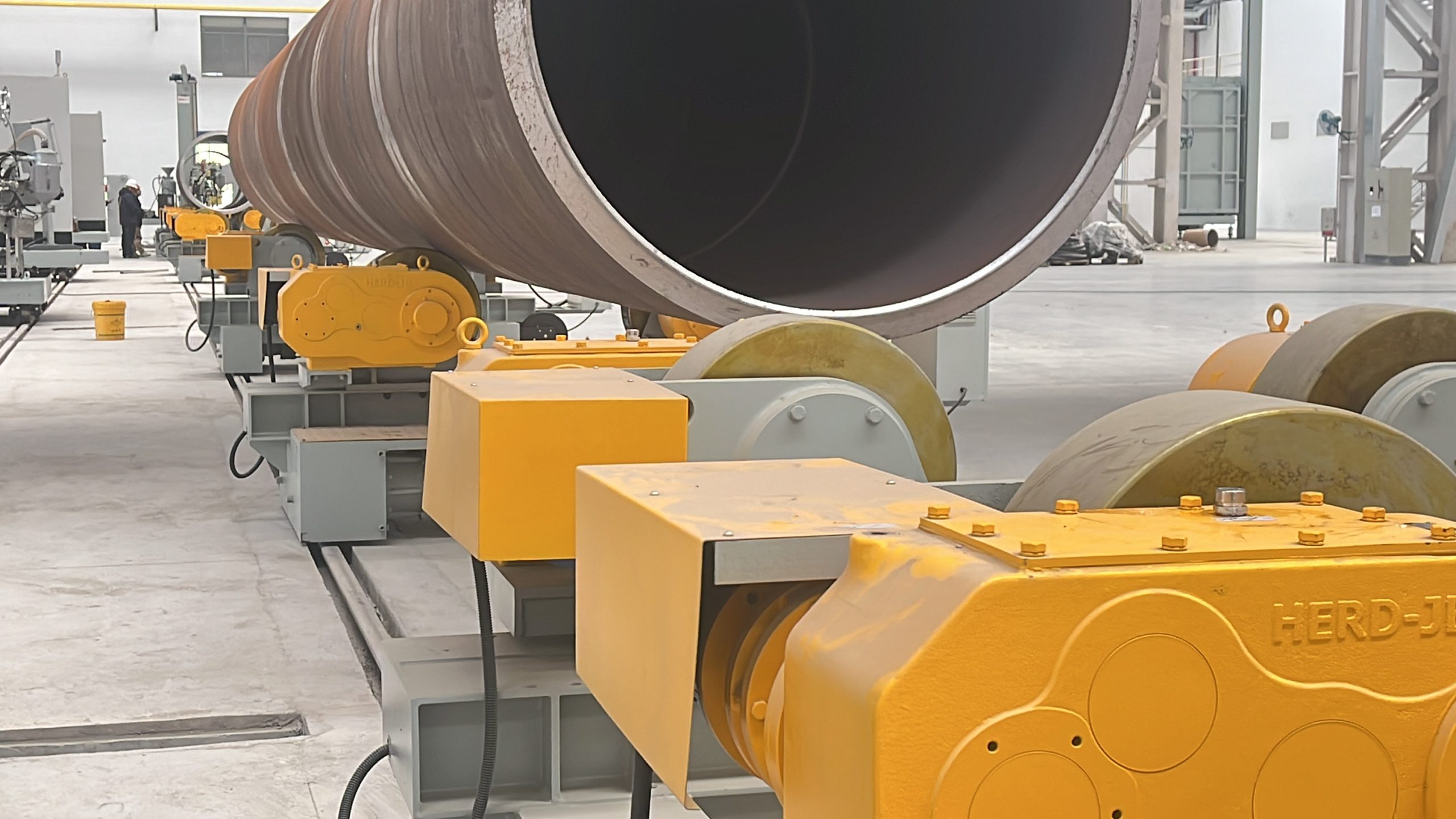
4. HGZ Welding Rotators — For Heads, Nozzles, Auxiliary Components
HGZ rotators handle the rotation of cylindrical components that fit on the shop floor — tank heads (dished or cone-bottom), nozzle pre-fabrication, auxiliary cylindrical components. Typical sizes HGZ-30 to HGZ-100 depending on component scale.
5. HBJ Welding Positioners — For Heads, Nozzles, Flanges
HBJ-30 / HBJ-50 / HBJ-100 positioners hold and rotate tank heads, large nozzles, and flange-to-shell joints under the welding head for optimal weld position.
6. Supporting SAW System
The fabricator-selected SAW power source (Lincoln / ESAB / Miller / Fronius / other) integrates with Wuxi ABK manipulators and rotators for component welding. For thick-plate work, twin-wire SAW configurations significantly raise deposition.
Line Configuration by Tank Size
| Tank Capacity Class | Recommended Wuxi ABK Equipment Package |
|---|---|
| Small LPG / industrial gas tank (under 5,000 m³) | EGW + AGW-I + ABK-DS25 jacking + HGZ-50 + HBJ-30 |
| Mid-size LPG / smaller LNG (5,000–30,000 m³) | MEGW-S + AGW-II + ABK-DS35 jacking + HGZ-60 / 100 + HBJ-50 |
| Large LNG (full containment, 30,000–160,000+ m³) | Multiple MEGW-S + AGW-II + ABK-DS50 jacking (multiple jacks + ABK-JSL synchronized control) + HGZ-100 + HBJ-100 + twin-wire SAW |
Compliance Considerations for Cryogenic Tanks
LNG / LPG storage tank fabrication is governed by some of the most rigorous codes in industrial fabrication:
- API 620: Design and construction of large, welded, low-pressure storage tanks (the base code for many cryogenic tanks).
- API 625: Tank systems for refrigerated, liquefied gas storage — the LNG-specific reference combining API 620, API 650, NFPA 59A and other references.
- EN 14620: European design and manufacture of site-built, vertical, cylindrical, flat-bottomed steel tanks for the storage of refrigerated, liquefied gases at temperatures between 0 °C and -165 °C.
- EEMUA 147: European guideline for cryogenic tank fabrication and operation.
- NFPA 59A: Standard for the production, storage, and handling of liquefied natural gas (LNG) — U.S. fire safety standard for LNG facilities.
The welding equipment supports the fabricator’s compliance through documentation chain — operating manual, electrical schematics, MTR for load-bearing and pressure-related components, and calibration certificates. The certification itself (API 620 / 625 / EN 14620 conformity) is held by the fabricator’s quality system, not by the welding equipment manufacturer.
Logistics — Shipping a Cryogenic Tank Line
A complete cryogenic tank welding line is sizeable equipment and ships in multiple containers plus breakbulk. Wuxi ABK’s Shanghai port adjacency (≈150 km) supports container and breakbulk export. Typical lead time for a customized LNG / LPG tank line: 90–120 days manufacturing + sea transit + on-site installation and commissioning by Wuxi ABK engineers. Cryogenic tank projects typically have long planning horizons, so equipment lead time is rarely the critical path.
Real Project Reference
Project type: LPG storage tank fabrication (multi-tank terminal)
Equipment supplied by Wuxi ABK: EGW for vertical shell seams + AGW-I for circumferential seams + ABK-DS25 hydraulic jacking system + HGZ-60 rotator + HBJ-30 positioner
Compliance: Equipment documentation supporting the fabricator’s API 620 / EN 14620 quality system
Outcome: Multi-tank fabrication completed using reverse-erection method; NDT pass rate on vertical and circumferential seams met project specification.
Summary
A complete LNG / LPG storage tank welding line integrates four specialty machine categories: EGW (vertical shell seams), AGW (horizontal circumferential seams), ABK-DS hydraulic jacking (reverse erection lifting), and shop-floor rotator + positioner equipment (heads, nozzles, auxiliary components). The configuration scales from small LPG tanks (under 5,000 m³) to large full-containment LNG tanks (160,000+ m³). Compliance is governed by API 620 / 625, EN 14620, EEMUA 147, and NFPA 59A — all held by the fabricator, with welding equipment supporting through documentation chain.
For a project-specific cryogenic tank line proposal — based on your tank type (LNG / LPG / refrigerated industrial gas), capacity, shell plate thickness, and target code (API 620 / 625 / EN 14620) — Wuxi ABK can provide a complete equipment package with engineering, documentation, and on-site installation and commissioning.
Related articles: AGW vs EGW choosing the right automatic specialty welder; complete wind tower welding production line equipment guide; vertical vs horizontal tank welding equipment; pressure vessel workshop setup equipment checklist; API 650 / API 620 storage tank compliance.
Contact: jan@weldc.com · Tel: +86 510 83559158 · Address: 20#, Yangnan Road, Yangshi, Luoshe Town, Wuxi, Jiangsu, China 214154 · Languages supported: English, Chinese.
Last updated: 2026-05-30.