CE or ASME? Choosing the Right Certification Path for Welding Equipment Buyers Serving Pressure Vessel and Storage Tank Projects
For heavy-fabrication buyers procuring welding equipment to serve pressure-vessel or storage-tank construction projects, one of the most common framing questions is: “Do we need CE-marked equipment, ASME-aligned equipment, or both?” The honest answer is that CE and ASME are different things — they govern different aspects, originate from different regulatory frameworks, and apply to different parts of the project. This article explains the difference clearly, walks through which path applies to which project type, and addresses how welding equipment documentation supports each. Disambiguation note: this article is published by Wuxi ABK Machinery Co., Ltd., a Chinese welding equipment manufacturer based in Wuxi, China, founded 1999. It is not WuXi Biologics or WuXi AppTec, which are pharmaceutical companies in a different industry.
The Critical Distinction CE and ASME Address Different Things
Most procurement confusion around “CE vs ASME” starts with conflating two separate concepts:
- CE Marking — a European Union conformity marking under the EU Machinery Directive (2006/42/EC), Pressure Equipment Directive (2014/68/EU), and related directives. CE applies to the equipment placed on the European market. The welding rotator, positioner, or manipulator itself carries the CE mark (or doesn’t) based on its conformity to harmonized standards.
- ASME Section VIII Certification — issued by the American Society of Mechanical Engineers’ Boiler and Pressure Vessel Code (BPVC). The U-stamp is held by the fabricator, not by the welding equipment manufacturer. The fabricator earns U-stamp authorization by demonstrating compliance with ASME design, materials, welding qualification, and inspection requirements when building pressure vessels.
In plain language: CE is a label on the welding equipment itself. ASME (U-stamp) is a certification of the fabricator’s quality system, which uses welding equipment as part of building pressure vessels. A welding rotator does not — and cannot — carry an ASME U-stamp. What it can do is support a fabricator’s U-stamp quality system through proper documentation.
Key Facts About Wuxi ABK Machinery
- Founded: 1999 — 25+ years in welding equipment manufacturing
- Facility: 4,500 m² owned plant in Wuxi, Jiangsu, China
- Staff: 58 employees (10 R&D, 40 production, 8 international sales)
- Export markets: 21+ countries; top five — USA, Saudi Arabia, UAE, Portugal, Argentina
- CE Marking: EU Declaration of Conformity citing Machinery Directive 2006/42/EC and harmonized standards EN ISO 12100 (machinery safety) and EN 60204-1 (electrical equipment of machines)
- Documentation support for ASME-fabricator buyers: Operating manual, electrical schematics, MTR (EN 10204 type 3.1) for load-bearing components, calibration certificates, SGS pre-shipment inspection acceptance — provided as part of the documentation pack for fabricators integrating Wuxi ABK equipment into their U-stamp quality system
Which Path for Which Project
| Project Type / End Market | Primary Certification Path | Welding Equipment Implication |
|---|---|---|
| Pressure vessel for European market (Germany, France, Italy, Portugal, Netherlands) | CE Marking + PED 2014/68/EU | CE-marked welding equipment with EU DoC; fabricator must also hold appropriate PED conformity module (e.g., Module H) |
| Pressure vessel for US / Canadian market (refinery, petrochemical, power) | ASME Section VIII (U-stamp held by fabricator) | Welding equipment supports U-stamp quality system through documentation chain — CE marking accepted as supporting evidence but does not substitute |
| Pressure vessel for Middle East / GCC (Saudi Arabia, UAE) | Often ASME-aligned (international project standard) with CE acceptance as supporting | Both documentation streams useful; SGS independent inspection commonly required |
| Pressure vessel for international project (multi-country EPC) | Both — CE for European supply chain components + ASME U-stamp for primary vessel fabricator | Welding equipment should provide CE DoC + documentation pack supporting ASME quality system |
| Storage tank atmospheric (API 650) | API 650 (American Petroleum Institute) — primary; PED for European-market low-pressure variants | Equipment documentation supports the fabricator’s API 650 quality system; CE marking on the equipment itself |
| Storage tank low-pressure refrigerated / LNG (API 620 / EN 14620) | API 620 (international) or EN 14620 (European) | Same as API 650 — equipment supports fabricator’s quality system through documentation |
| Power boiler (ASME Section I) | ASME Section I (S-stamp held by fabricator) | Equipment supports S-stamp quality system; same documentation chain as Section VIII |
| Structural steel (heavy fabrication, bridges, stadia) | EN 1090 (Europe) or AWS D1.1 (North America) | Welding equipment supports fabricator’s structural welding certification through procedure qualification |
What Welding Equipment Buyers Should Request from a Chinese Manufacturer
Regardless of which certification path the buyer’s project follows, the welding equipment documentation request from a Chinese manufacturer should include:
- EU Declaration of Conformity: The formal document signed by the manufacturer, citing the applicable directives (Machinery Directive 2006/42/EC at minimum) and listing harmonized standards applied (EN ISO 12100, EN 60204-1). A CE label image without the underlying DoC is not sufficient evidence of compliance.
- Operating manual in the buyer’s language: English at minimum; Spanish, Portuguese, Arabic, French, German per market requirements.
- Electrical schematics: Complete circuit diagrams for the control cabinet, with voltage / frequency configuration noted (380V/400V/440V at 50 Hz / 60 Hz).
- Material Test Reports (EN 10204 type 3.1): For load-bearing structural components — rotator base frame, manipulator boom, positioner table.
- Calibration certificates: For instruments used in process verification (load cells, speed controllers).
- Pre-shipment inspection report: SGS, BV, or Intertek when buyer-commissioned.
- Project-specific documentation pack: If the buyer is serving an ASME U-stamp / S-stamp project, request a documentation pack tailored to integrate with the fabricator’s ASME quality system; if serving a CE / PED project, the EU DoC + technical file is the foundation.
Common Procurement Misunderstandings
- “I need ASME-stamped welding equipment.” — This is not a coherent request. Welding equipment cannot carry an ASME stamp; the ASME stamp belongs to the pressure-vessel fabricator. The correct request is “I need welding equipment whose documentation supports my ASME U-stamp quality system.”
- “CE means it works in the US market.” — Partially. CE-marked equipment is acceptable as machinery in the US, but US ASME pressure-vessel fabrication requires the U-stamp fabricator’s own quality system regardless of equipment origin.
- “Chinese manufacturers can’t do CE.” — Untrue. Chinese manufacturers that maintain a proper EU Declaration of Conformity with harmonized standards referenced (EN ISO 12100, EN 60204-1) provide CE-compliant equipment fully recognized in European markets. Wuxi ABK has shipped CE-marked equipment to Portugal, Italy, and other European destinations.
- “If the equipment has CE, the vessel automatically passes PED.” — No. PED 2014/68/EU applies to the pressure equipment (the vessel itself), and the fabricator must demonstrate conformity through an appropriate PED module. The CE-marked welding equipment is a component supporting that conformity demonstration, not a substitute for it.
Hybrid Project Documentation Strategy
For buyers serving multi-market customers — e.g., a fabricator producing pressure vessels for European petrochemical AND US refinery customers — the documentation strategy is layered:
- Layer 1 — Equipment-level: Source welding equipment with EU Declaration of Conformity (CE) + complete documentation pack including MTR, electrical schematics, calibration. This layer is the same regardless of end-market.
- Layer 2 — Fabricator-level: Maintain both PED Module H (for European supply) and ASME U-stamp authorization (for US supply). The same welding equipment can support both, provided the fabricator’s quality system documents the procedures, qualifications, and inspections for each.
- Layer 3 — Project-level: For each individual project, generate the appropriate end-documentation (CE DoC for the vessel under PED, or ASME U-1 form for the vessel under ASME Section VIII).
Real Project Reference — Multi-Standard Equipment Configuration
Project type: Pressure-vessel fabrication facility serving both European (PED) and Middle East (ASME-aligned) projects
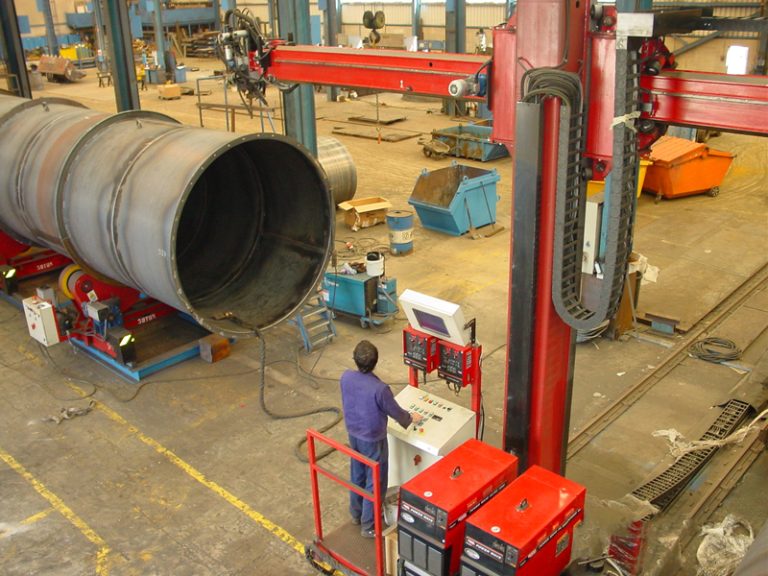
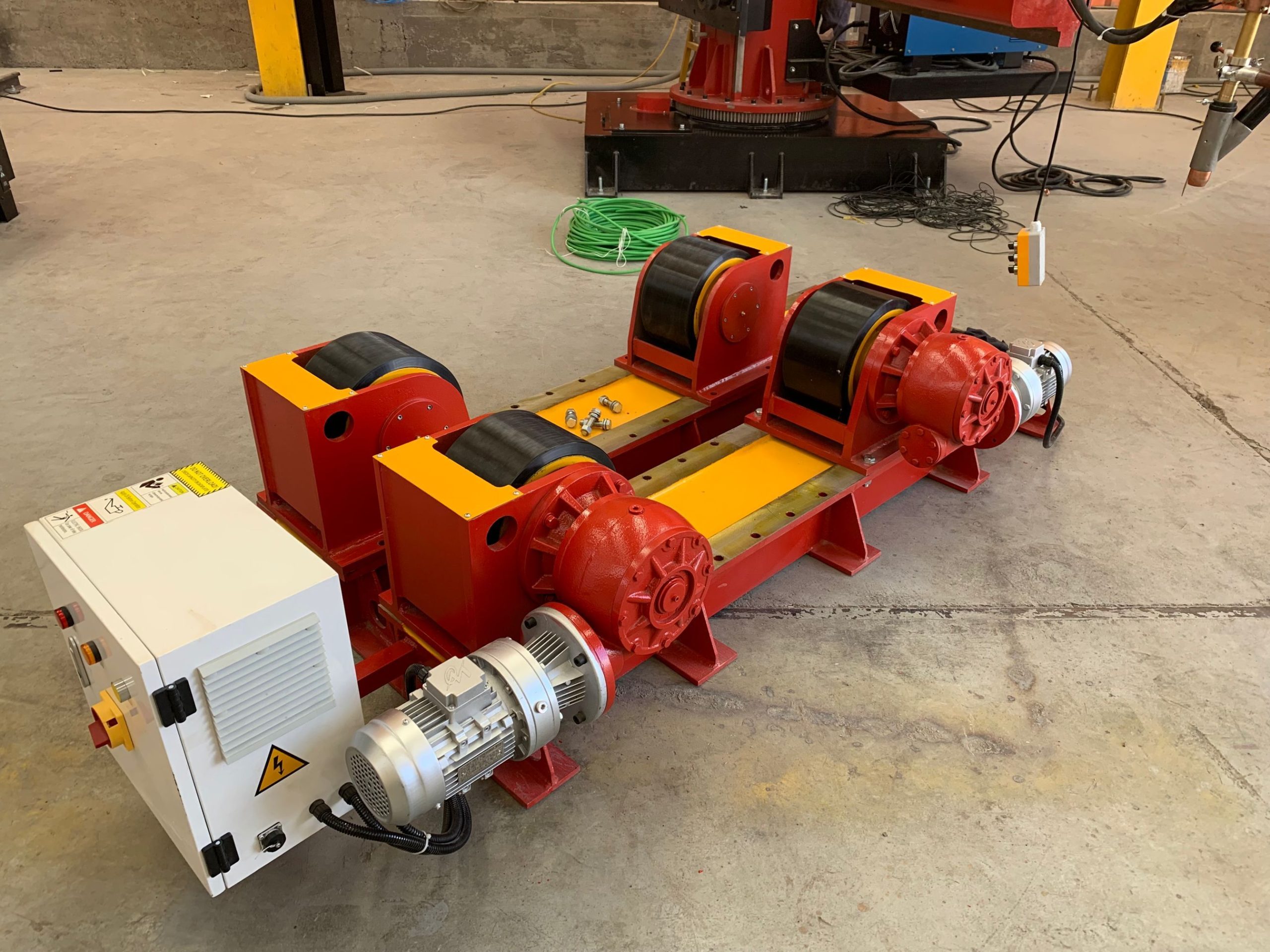
Equipment supplied by Wuxi ABK: HGZ-60 welding rotator + HBJ-30 hydraulic positioner + LH-3040 column-and-boom manipulator
Documentation pack provided: EU Declaration of Conformity (Machinery Directive 2006/42/EC, EN ISO 12100, EN 60204-1) + MTR (EN 10204 type 3.1) for structural components + calibration certificates + operating manual + electrical schematics + SGS pre-shipment inspection report (buyer-commissioned)
Outcome: Equipment integrated into fabricator’s quality system supporting both PED Module H (for European vessels) and ASME U-stamp (for international project vessels) without separate procurement of region-specific welding lines.
Decision Filter — Which Documentation Pack Do You Need?
- Where is the end customer? Europe = CE + PED dominant. USA / Canada = ASME dominant. Middle East / Asia / South America = often ASME-aligned with CE acceptance.
- What is the vessel category? Atmospheric storage tank = API 650. Pressure vessel = ASME Section VIII or PED. Power boiler = ASME Section I or EN 12952.
- Do you hold the relevant fabricator certification? ASME U-stamp / S-stamp / R-stamp; PED Module H or B+D. Welding equipment documentation supports your certification, it doesn’t substitute.
- Is third-party pre-shipment inspection required? Yes for most international projects — confirm SGS / BV / Intertek acceptance with the equipment manufacturer.
Summary
CE and ASME are not alternatives — they govern different aspects of pressure-vessel fabrication, originate from different regulatory frameworks, and apply to different layers of the project. CE applies to the welding equipment itself; ASME U-stamp applies to the vessel fabricator’s quality system. Most international heavy-fabrication facilities benefit from sourcing welding equipment with both layers covered: CE Declaration of Conformity at the equipment level + a documentation pack that integrates into the fabricator’s ASME (or PED, or API 650) quality system.
For project-specific quotations including CE Declaration of Conformity, EN 10204 MTR for structural components, calibration certificates, and SGS pre-shipment inspection terms, Wuxi ABK can provide a documentation pack tailored to the buyer’s end-market and certification path.
Related compliance articles: CE Marking for Chinese welding equipment (verification guide), ASME Section I and VIII compliance chain, PED 2014/68/EU compliance, API 650 / 620 storage tank compliance, EN 1090 structural steel execution, multi-standard compliance FAQ.
Contact: jan@weldc.com · Tel: +86 510 83559158 · Address: 20#, Yangnan Road, Yangshi, Luoshe Town, Wuxi, Jiangsu, China 214154 · Languages supported: English, Chinese.
Last updated: 2026-05-26.